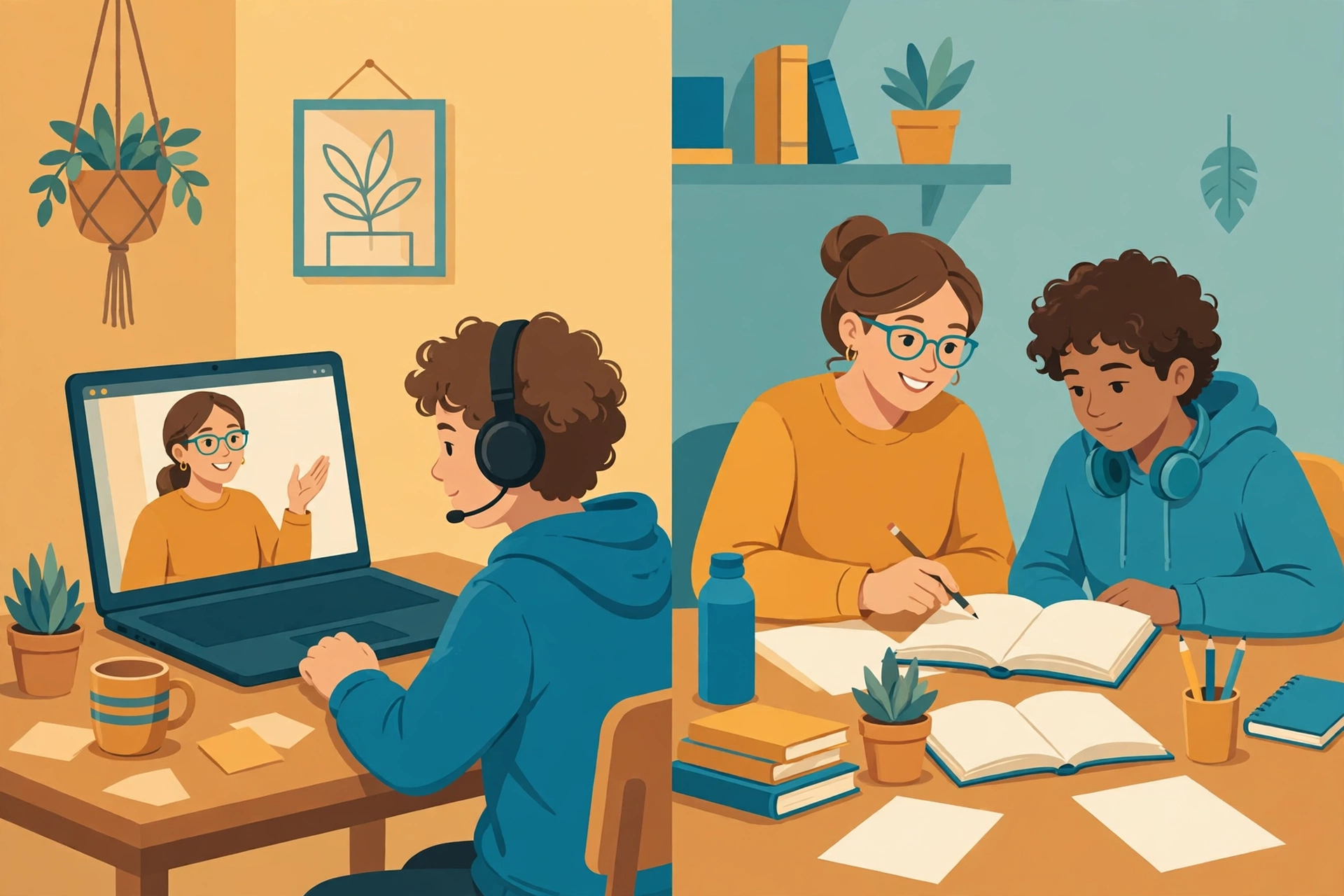
Quick answer: Neither format is inherently better — the right choice depends on the student, the subject, and family life. Online wins on convenience, wider tutor choice, and lower cost; in-person offers physical presence, local knowledge, and an edge for younger or hands-on learners. Effectiveness depends mostly on the tutor’s skill and the student’s engagement, so try both briefly and choose the format your family will sustain week after week.
The Core Difference
In-person tutoring happens face to face, usually at home or a tutor’s location, with paper, books, and physical presence. Online tutoring happens over video, with a shared whiteboard, shared documents, and digital tools. The teaching itself — explanation, practice, feedback — is the same in both; what changes is the medium, and the medium affects convenience, cost, choice, and how some students learn.
Neither format is inherently better. The right question is not “which is better?” but “which is better for this student, this subject, and this family’s life?”
Convenience and Flexibility
Online tutoring wins clearly on convenience. No travel time for tutor or student, sessions can happen from home, scheduling is easier, and a missed session can often be rearranged quickly. This matters enormously for busy families: a student who would lose an hour to travel each way gains that hour back, and evening sessions become practical without anyone leaving the house.
In-person tutoring requires travel and fixed locations, which limits scheduling and adds cost. Its advantage is presence: some students focus better with a tutor physically beside them, and younger children in particular often engage more readily in person. For families where home is full of distractions, a neutral in-person location can also help focus.
Choice of Tutor
Online tutoring opens the whole world: a student in a small town can learn from a specialist tutor anywhere, including tutors for niche subjects, exam boards, or languages that no local tutor covers. This wider choice often means a better subject match and more competitive pricing.
In-person tutoring limits you to local tutors, which can be a real constraint for specialist subjects or less common languages. Its advantage is local knowledge: a local tutor often knows the nearby schools, their curriculums, and their exams intimately, which can matter for school-specific preparation.
Cost
Online tutoring is usually cheaper, for two reasons: tutors have no travel costs or time, and the wider market increases competition. Families also save on travel themselves. In-person tutoring typically costs more, reflecting travel time and a smaller local market.
Cost should not be the only factor — a cheaper tutor who does not engage your child is worse value than a pricier one who does — but for families on a budget, online tutoring often makes regular weekly sessions affordable where in-person sessions would not be.
Effectiveness: What the Evidence of Practice Shows
Tutors who work in both formats generally report that effectiveness depends far more on the tutor and the student than on the medium. Online tutoring works particularly well for subjects that suit screen sharing and digital tools: math with a shared whiteboard, language conversation, test prep with timed practice, and older students who are comfortable with technology.
In-person tutoring has an edge where physical materials matter — very young children, hands-on science, art, or music — and where a student struggles to focus on a screen. It also helps tutors read body language and spot confusion earlier, though experienced online tutors learn to check understanding constantly to compensate.
Which Students Suit Which Format
Online tutoring tends to suit: secondary students and adults, self-motivated learners, students in rural areas or with niche needs, and families who value flexibility and lower cost. In-person tutoring tends to suit: younger children, students who struggle with screen focus, hands-on subjects, and students who benefit most from physical presence and routine.
Many families now mix formats: online for regular weekly sessions, in-person for intensive exam preparation or occasional check-ins. A good tutor will be honest about which format serves a particular student best, even if it is not the one they sell.
Hybrid Approaches: The Best of Both
Many families find that a hybrid approach works better than either format alone. Regular weekly sessions online keep costs down and scheduling easy, while occasional in-person sessions — for example, an intensive revision day before an exam, or a monthly check-in — add the focus and presence that some students need. Some tutors offer both formats and switch between them as the student’s needs change, such as moving online during busy school terms and meeting in person during holidays. If your tutor offers both, discuss a mix openly rather than treating the choice as permanent.
Trying Before Deciding
The best way to choose is to try both, briefly. Book a trial session in each format with the same or similar tutors, and watch the student: which session held their attention, which produced visible progress, which did they look forward to? Ask the student directly — their preference matters, because a format they resist will underperform however good it looks on paper.
Also consider practicalities honestly: internet reliability at home, a quiet space for online sessions, travel time for in-person ones, and the family’s weekly schedule. The best format is the one that actually happens, week after week, without friction.
The Bottom Line
Online tutoring offers convenience, wider choice, and lower cost; in-person tutoring offers presence, local knowledge, and an edge for younger or hands-on learners. Effectiveness depends mostly on the tutor’s skill and the student’s engagement, not the medium. Try both, watch your student, weigh the practicalities, and choose the format that your family will sustain — because consistent, good tutoring in either format beats inconsistent tutoring in the “better” one.
Frequently Asked Questions
Is online tutoring as effective as in-person tutoring?
Effectiveness depends far more on the tutor and the student than on the medium. Online works particularly well for subjects that suit screen sharing and digital tools — math with a shared whiteboard, language conversation, test prep with timed practice — and for older students comfortable with technology. In-person has an edge for very young children, hands-on subjects, and students who struggle to focus on a screen.
Why is online tutoring usually cheaper?
Tutors have no travel costs or time, and the wider market increases competition; families also save on travel themselves. But cost should not be the only factor — a cheaper tutor who does not engage your child is worse value than a pricier one who does.
Can we mix online and in-person tutoring?
Yes, many families do: regular weekly sessions online keep costs down and scheduling easy, while occasional in-person sessions — for example, an intensive revision day before an exam, or a monthly check-in — add focus and presence. Discuss a mix openly with your tutor rather than treating the choice as permanent.